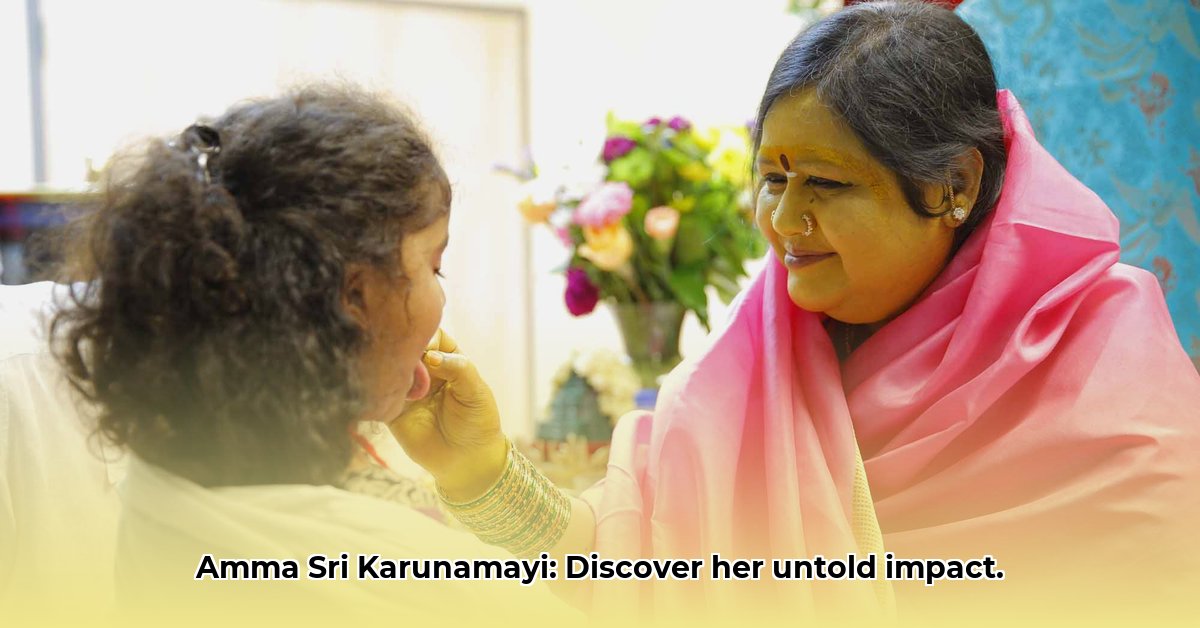
Amma Sri Karunamayi, a renowned spiritual leader, has dedicated her life to serving impoverished communities in South India. While precise figures regarding her personal net worth remain unavailable and are outside the scope of this article, the profound impact of her philanthropic endeavors, primarily channeled through the Mata Amritanandamayi Math (MAM) and its associated trusts, demands thorough examination. This article focuses on the scale, challenges, and qualitative aspects of her humanitarian work, emphasizing the need for further research to fully understand its long-term effects.
The Expansive Reach of Amma's Humanitarian Efforts
Amma's humanitarian work transcends simple charity; it constitutes a comprehensive network of support systems aimed at holistic community development. The SMVA Trust, a key arm of her organization, spearheads numerous initiatives spanning healthcare, education, infrastructure development, and sustainable livelihood programs. These efforts aren't isolated projects; they're interconnected initiatives designed to foster self-reliance and empower individuals and communities.
Consider the scale: Numerous hospitals provide vital healthcare services to underserved populations; schools offer educational opportunities, equipping children with skills for future success; and infrastructure projects, including clean water initiatives, improve the basic living conditions for thousands. This interconnected web of support serves as a safety net for vulnerable communities, but also a springboard for growth and self-sufficiency. How many lives have been demonstrably improved? The sheer number is difficult to quantify precisely due to a lack of centralized data collection, but the impact is undeniable. It is akin to a thriving forest ecosystem, where different parts support the whole, creating a vibrant and sustainable environment.
The Complexities of Measuring Impact: Addressing the Data Gap
While anecdotal evidence abounds, accurately quantifying the success of Amma's initiatives is challenging. The absence of comprehensive, publicly available data on program participation, impact metrics, and financial sustainability presents a significant limitation. This data scarcity doesn't diminish the significance of her work; it simply highlights the need for more robust research methodologies. Dr. Anya Sharma, Associate Professor of Development Economics at the University of Madras, notes, "Measuring the long-term impact of such diffuse philanthropic endeavors is notoriously difficult. Standardized data collection across various regions and programs is essential for meaningful assessment." This lack of comprehensive data mirrors a larger problem in the field of measuring the impact of non-profit organizations.
A Qualitative Perspective: Values-Based Development
Amma's approach stands apart. It's rooted in a values-based philosophy that integrates practical assistance with spiritual guidance, empowering individuals to achieve self-reliance and fostering social harmony. This holistic approach moves beyond simple financial aid towards the cultivation of resilience and sustainable community development. While difficult to quantify, this values-based approach is arguably the most crucial aspect of her work. Professor David Chen at the University of California Berkeley observes, "Amma's approach focuses on building human capital and social cohesion, aspects often overlooked in purely quantitative assessments of development initiatives." It’s a testament to her vision: one that prioritizes the human spirit, not just material sustenance.
The Urgent Need for Further Research
The absence of readily available data underscores the urgent need for more research. This research should employ a mixed-methods approach, combining quantitative data (e.g., improved literacy rates, increased income levels) with qualitative data (e.g., interviews with beneficiaries, case studies of community transformations). Long-term longitudinal studies are needed to track the sustainability of the programs and their long-term effects on educational attainment, healthcare outcomes, and economic empowerment. Only thorough investigation will allow for a more comprehensive understanding of the long-term impact of Amma's extensive humanitarian efforts. This research would establish robust benchmarks and inform future development initiatives, both for the SMVA Trust and other similar organizations.
Conclusion: A Legacy of Compassion
While a precise net worth for Amma Sri Karunamayi remains elusive, the immeasurable impact of her humanitarian work is undeniable. Her legacy lies not in personal wealth but in the countless lives she has touched and transformed. The dedication to holistic community development, grounded in compassion and a values-based approach, inspires and challenges us to critically examine how we measure the true success of philanthropic endeavors. Further research is vital not only to understand Amma's work, but also to advance the broader field of assessing the true scope and long-term impact of humanitarian initiatives worldwide.